
The Song of the Lark
First published 1915 Reading time about 10 hours
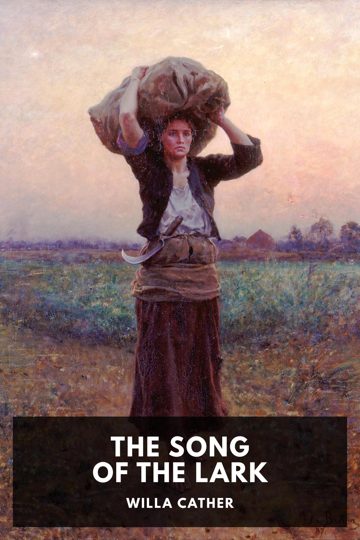
The Song of the Lark, Willa Cather’s third novel, was written in 1915. It is said to have been inspired by the real-life soprano Olive Fremstad, a celebrated Swedish-American singer who, like the protagonist, was active in New York and Europe during the time period depicted in the novel. The work explores how an artist’s early life influences their work. In the novel, Thea Kronborg discovers her talent as a singer, and goes on to achieve great fame and success once she leaves her tiny village of Moonstone. Cather eschewed depicting rural life as being idyllic, instead focusing on the conservative, restricted, patriarchal structures that its inhabitants live by. Her work is thus considered to be one of the earliest so-called “Revolt Novels.” She depicts a time at the end of the 19th century when the American West was expanding rapidly and Americans were gaining sophistication in their understanding of culture and artists, particularly compared to Europe. The title of the novel comes from the name of a 1884 painting by Jules Breton, which is described and considered in the book itself.
- Musical fiction
- Young women · Fiction
- Bildungsromans
- Chicago (Ill.) · Fiction
- Swedish Americans · Fiction
- Colorado · Fiction
- Opera · Fiction
- Children of clergy · Fiction
- Women singers · Fiction
Read it on Firelit Reader
With explanations of any passage, a built-in dictionary and notes that open in place. Join the waitlist and we'll write once when Firelit Reader is available.